
Science behind the idea
MARINIX Carbon Dioxide Removal Technology
The MARINIX carbon dioxide removal technology is a new method of inducing Marine snow formation in the Southern oceans to absorb excess carbon dioxide from the atmosphere. Natural technology could remove up to 20% of the world’s annual emissions.
By minimally increasing the amount of iron chelates in the High Nitrate – Low Chlorophyll regions of the world´s oceans, MARINIX Ocean Tech induces the formation of Marine snow. Marine snow can remove “new” carbon from the ocean surface down to the deep-sea floor. The ocean surface can then again capture new atmospheric carbon. This process will remove atmospheric carbon, bury it on the deep ocean floor, and restore it as carbon captured in organic matter.
Unlike previous research projects, MARINIX is not meant to induce phytoplankton blooms. The MARINIX technology induces the formation of Marine snow by triggering an elevated release of extracellular organic carbon by existing communities of phytoplankton and heterotrophic bacteria. The microorganisms actively growing within the marine snow organic matrix remove carbon from the ocean surface through photosynthesis and store it on the deep ocean floor.
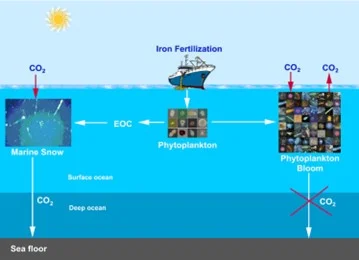
Marine snow is a previously neglected natural oceanic system which has been described as “the major pathway of organic carbon from the ocean surface to the ocean floor” (Fowler & Knower, 1986). The requirement for burying CO2 is that marine snow gradually but steadily becomes heavy enough to sink to the ocean floor.
This new natural carbon capture and storage (CCS) method, developed by Prof. Stasa Puskaric, relies on small amounts of iron (kilograms), to trigger the formation of marine snow and stimulate the functioning of the “biological pump”. The Marine snow aggregates will in time become increasingly heavy and sink below the ocean surface, taking all the carbon to the sea floor, never to be returned to the atmosphere.
This process is the only natural system powerful enough to reverse the current trends of global warming.
AI and technology
We developed the Light Spectrum Replicator (LSR), which is a device capable of incubating 12 samples in parallel using a customized light spectrum. The device relies on artificial intelligence methods to replicate the environment from which the sample is taken. This includes the utilization of deep learning networks and evolutionary-inspired metaheuristic optimization algorithms such as “Genetic Algorithm”. Using the LSR device, we made a database of 10000 light spectrum curves, which were used to optimize and discover the light spectrum we needed to replicate during the experiment. The entire framework is implemented in Python using a popular machine-learning library called PyTorch.
Sensors
A unique combination of newly designed sensors capable of estimating direct (real-time) ocean carbon pathways. Using the sensor system, we are able to predict, estimate and understand the carbon pathway. The carbon pathway starts in the atmosphere, where it can be absorbed into the oceans and is part of microbial communities. The microbial communities are one of the causes of dissolved organic matter in the ocean. Dissolved organic matter is then turned into marine snow and its fate – burial in the deep sediments of the ocean or becoming part of the refractory segment of dissolved organic matter in the deep ocean waters.
Let's do it together
Together, let’s forge a path towards a world that thrives on innovation and environmental stewardship, one token at the time. Dare to dream, invest in impact, and let’s create a legacy that resonates through generations!